
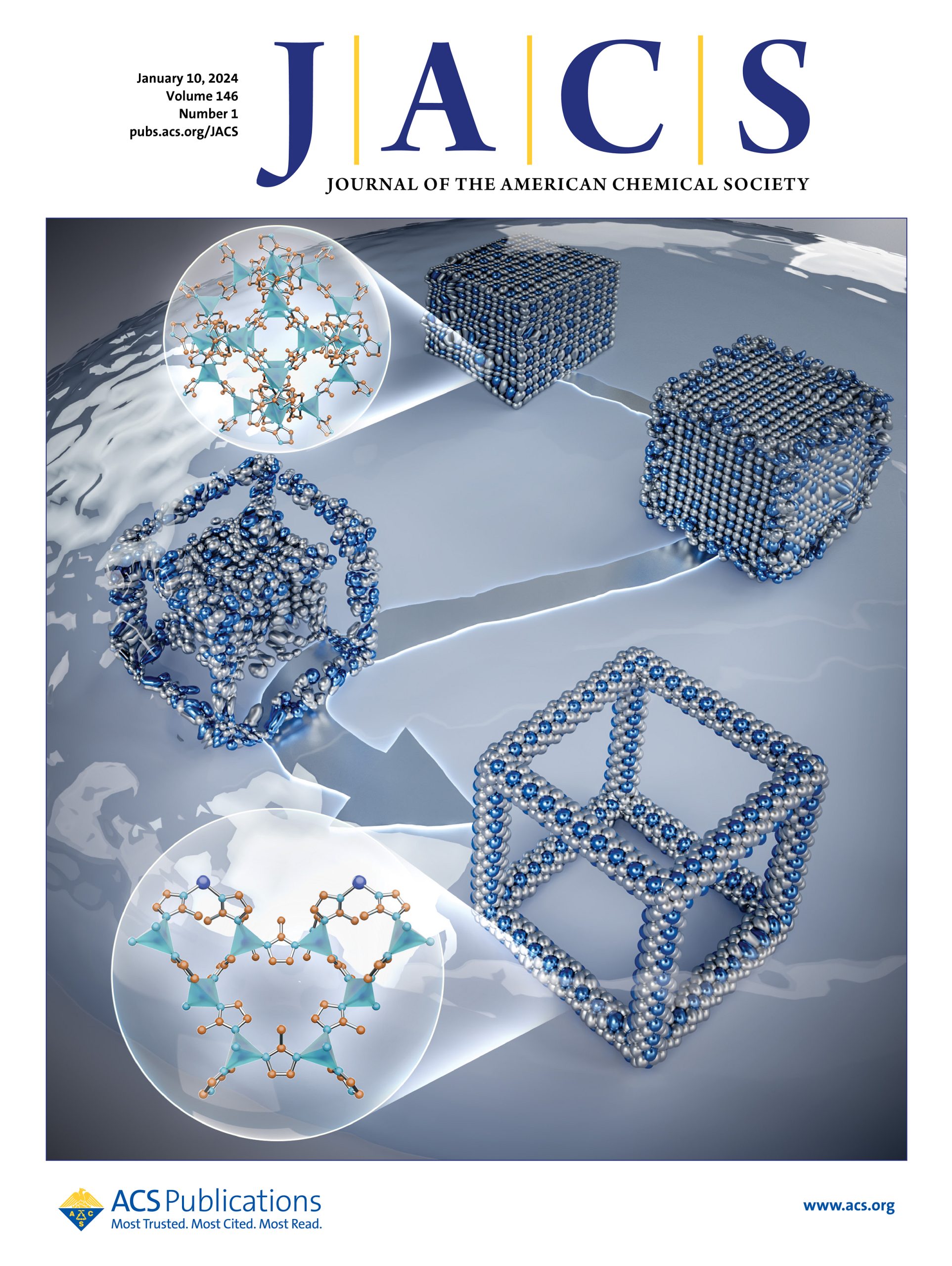
Congratulations, our paper Transformation of ZIF-67 Nanocubes to ZIF-L Nanoframes was published in Journal of the American Chemical Society, and was selected as the cover of the journal.
Metal-organic framework ( MOF ) is a multifunctional porous material composed of inorganic building units connected by organic connectors. Due to its remarkable specific surface area and highly adjustable structural characteristics, MOF has been widely used in energy storage, catalysis, medicine and gas absorption. Over the past decade, extensive research on the nucleation and growth of MOFs has proposed a variety of different nucleation mechanisms and crystal growth models, including classical nucleation theory, secondary building unit theory, and non-classical theory, which are used to explore mechanisms, guide synthesis, and optimize structures. However, there are still some challenging problems about the crystal growth mechanism of MOFs that have not been solved, especially the crystal transformation between MOFs involving the same building unit.
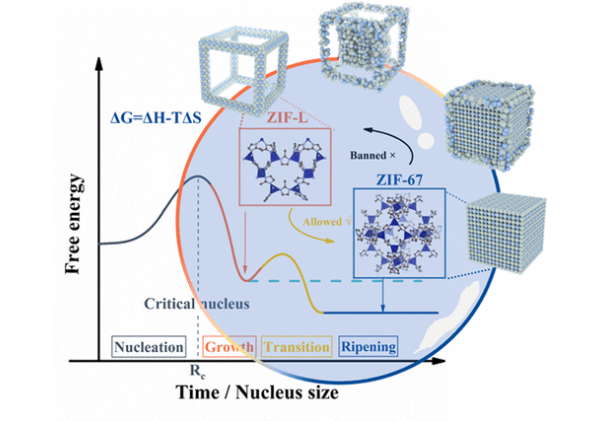
In this work, the author developed a simple supersaturation adjustment and particle dynamics control strategy, using the Marangoni circulation in the microdroplet as a driving force to overcome the thermodynamic barriers, and successfully realized the perfect transformation from the 3D ZIF-67 cube to the 2D ZIF-L framework. The velocity field, temperature field and concentration field in the droplet were simulated by designing control experiments and finite element analysis. It was found that the Marangoni circulation effectively enhanced the mass transfer and heat transfer, and created a uniform and rich 2D ZIF-L growth environment, thus successfully achieving the transition from 3D ZIF-67 to 2D ZIF-L. In addition, the finite element simulation intuitively shows how the changes in temperature and droplet size affect the heat and mass transfer, particle motion and concentration distribution of the building unit, providing a deeper perspective for the crystallographic transformation. In addition, the universality of this method for the transformation of ZIF crystals with the same sodalite structure was verified.